
Income taxes and deductions
Every plan year, the planner fills in a simplified Form 1040 and works out federal and state income tax. This chapter explains the rules it follows, using 2026 values. Each later year, the bracket edges and deductions rise with the tax forms inflation rate.
From income to taxable income
- Total income (line 9) adds wages, taxable interest, dividends, IRA and 401(k) withdrawals, pensions, the taxable part of Social Security and capital gains.
- Adjusted gross income (AGI, line 11a) is the same in the planner, because it does not model the adjustments on Schedule 1.
- Subtract the deductions (line 14): the standard deduction, the age 65+ add-on and, in 2025-2028, the senior deduction.
- What remains is taxable income (line 15), which is taxed by the brackets.
Tax-exempt interest (line 2a) and Roth withdrawals are not in total income.
Brackets: marginal and effective rates
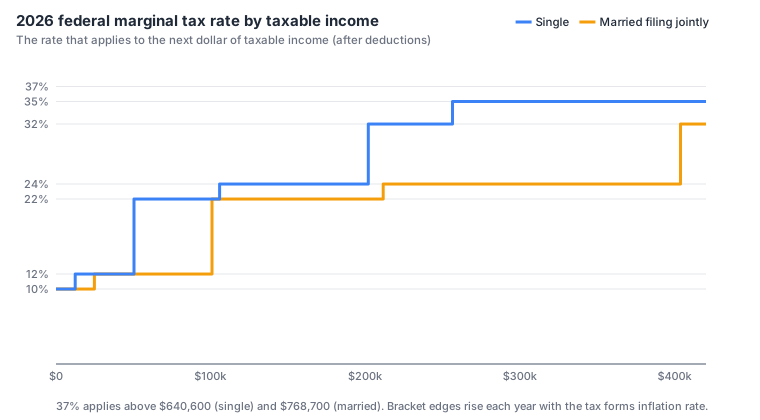
| Rate | Single, taxable income up to | Married filing jointly, up to |
|---|---|---|
| 10% | $12,400 | $24,800 |
| 12% | $50,400 | $100,800 |
| 22% | $105,700 | $211,400 |
| 24% | $201,775 | $403,550 |
| 32% | $256,225 | $512,450 |
| 35% | $640,600 | $768,700 |
| 37% | above that | above that |
Tax brackets are marginal: each slice of income is taxed at its own rate, so moving into a higher bracket never makes your earlier income cost more.
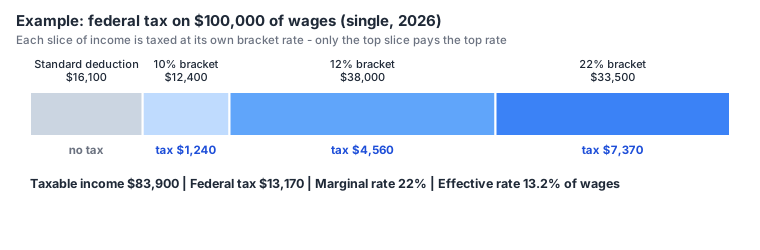
On $100,000 of wages a single filer has $83,900 of taxable income and pays $13,170. The marginal rate - the tax on the next dollar - is 22%, but the effective rate - tax divided by income - is only 13.2%. Decisions about extra income, like a Roth conversion, depend on the marginal rate.
Deductions and age-related tax breaks
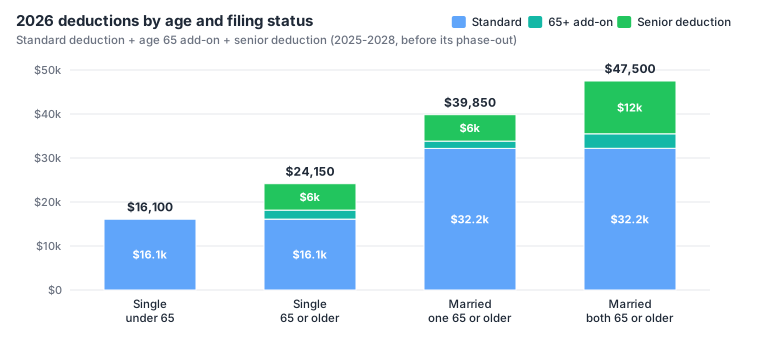
| Deduction (2026) | Single | Married jointly | Notes |
|---|---|---|---|
| Standard deduction | $16,100 | $32,200 | Rises with tax forms inflation. |
| Additional amount, 65 or older | $2,050 | $1,650 each | Per person 65 or older at the end of the year. Rises with inflation. |
| Senior deduction | $6,000 | $6,000 each | 2025 to 2028 only, per person 65 or older; phases out (below). Not inflated. |
The senior deduction phase-out
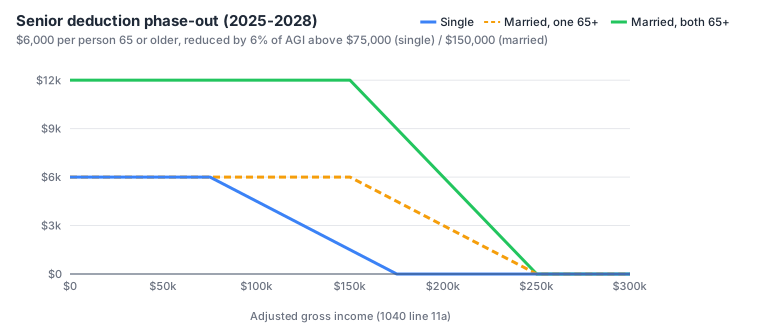
For 2025 through 2028, each person 65 or older can deduct an extra $6,000. Each $6,000 is reduced by 6% of adjusted gross income above $75,000 (single) or $150,000 (married filing jointly), so it is gone at $175,000 single and $250,000 married. The planner shows it on line 13b. Large Roth conversions or IRA withdrawals in these years can shrink it - another reason to look at the marginal cost of extra income.
Capital gains and qualified dividends
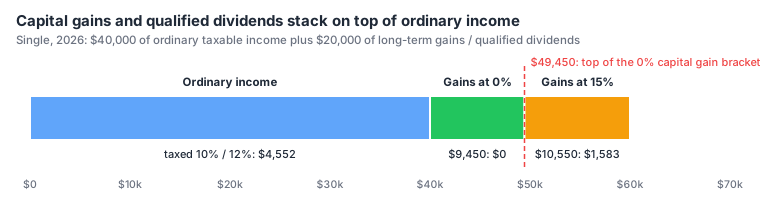
Long-term capital gains and qualified dividends have their own lower rates - 0%, 15% or 20% - and they are stacked on top of ordinary income. The 0% rate applies only to the part that fits below $49,450 (single) / $98,900 (married) of total taxable income. In the example, $9,450 of the gains are tax free and the remaining $10,550 cost $1,583.
- Gains come from selling investments in taxable accounts: proceeds minus the average cost basis.
- A net loss reduces income by at most $3,000 a year; the rest is not carried forward in the planner.
- Because these gains sit on top, a low-income year in early retirement can be a chance to sell at 0%.
Social Security benefits
Up to 85% of Social Security benefits can be taxable, depending on your other income. The planner fills in the Social Security benefits worksheet each year; see how Social Security is taxed.
State income tax
State tax uses the state brackets in Income Brackets on federal taxable income plus tax-exempt interest. The planner starts with a 4% flat placeholder - replace it with your state's brackets, or 0% if your state has no income tax.
Medicare premiums
Medicare premiums are not a tax, but they depend on your income from two years earlier. See Medicare and IRMAA.
How taxes are paid
Income is paid in full with no withholding. After the year's expenses, the planner works out the federal tax, state tax and Medicare premiums and pays them with Auto. A withdrawal from an IRA to pay the tax is itself taxable, so the planner recalculates until the bill is fully covered. The Annual Tax Forms view shows every line for every year.