
Social Security
Social Security is often the largest and safest income in retirement, and when you claim it is one of the biggest decisions you make. The planner pays each tax payer's benefit from their claim age, adjusts it for inflation and works out how much of it is taxable.
Your benefit depends on your claim age
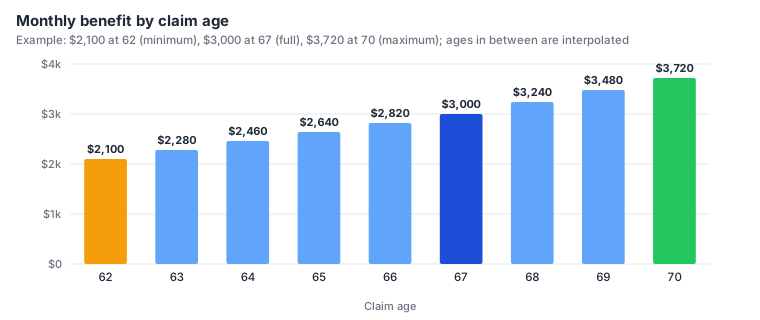
On the Tax Payers page you enter three monthly estimates from your Social Security statement: at the minimum age (62), your full retirement age (66 or 67) and the maximum age (70). For any claim age in between, the planner draws a straight line between these amounts - claiming at 65 in the example pays $2,640 a month. Claiming before 62 pays the minimum; after 70, the maximum.
Claiming early or late: the break-even age
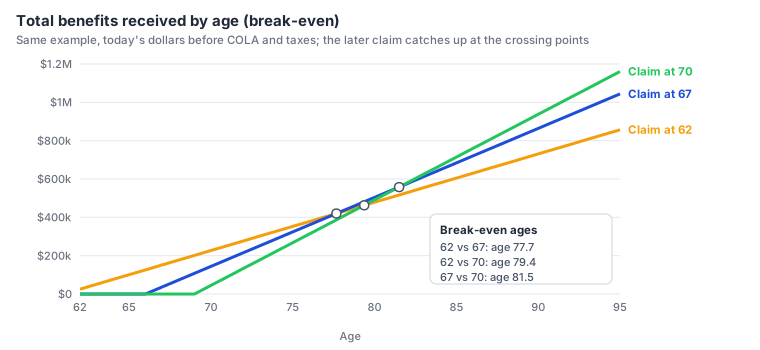
Claiming early gives you more years of smaller checks; waiting gives fewer years of larger ones. In the example the later claim catches up at about age 77.7 (62 versus 67), 79.4 (62 versus 70) and 81.5 (67 versus 70). If you expect to live past these ages, waiting usually pays more in total - and a larger benefit also means a larger survivor benefit for a spouse. The optimizer tests your three claim ages together with everything else, including taxes.
How payments are calculated each year
- Payments start in the year the tax payer reaches the claim age: monthly amount × 12.
- They rise every year with the general inflation rate, like Social Security's cost-of-living adjustment (COLA), measured from plan year 1 - because your estimates are in today's dollars.
- They are multiplied by the Social Security adjustment factor in General Settings (85% to start). It lets you plan for a possible future benefit cut; use 100% for none.
- Payments go into the cash account.
Survivor benefits
When one spouse dies, the survivor keeps the larger of their own benefit and the deceased spouse's benefit - if the deceased had already claimed it. The survivor's smaller benefit stops. The planner does not apply the reductions that apply to a survivor who claims early.
How Social Security is taxed
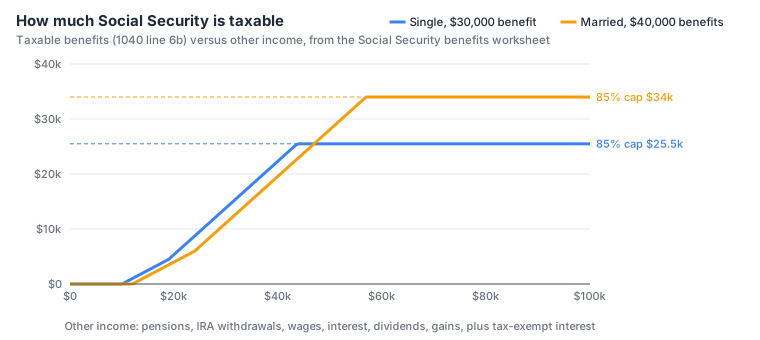
Between 0% and 85% of your benefits are taxable. The planner fills in the IRS Social Security benefits worksheet every year:
- Add half of your benefits to your other income, including tax-exempt interest (worksheet lines 1-7).
- Up to the base amount ($25,000 single, $32,000 married) none of the benefits are taxable.
- Between the base amount and the base plus the additional amount ($9,000 single, $12,000 married), 50 cents of benefits become taxable per dollar of income.
- Above that, 85 cents per dollar - until 85% of the benefits are taxable.
These thresholds are set in law and are not adjusted for inflation, so over time more people pay tax on their benefits. In the example, a single person with $30,000 of benefits and $40,000 of other income has $22,350 of taxable benefits.