
Required minimum distributions (RMDs)
Traditional IRAs and 401(k)s were funded with untaxed money, so the IRS requires you to start taking money out - and paying tax on it - at a certain age. These required minimum distributions grow as a share of the account every year.
When RMDs start
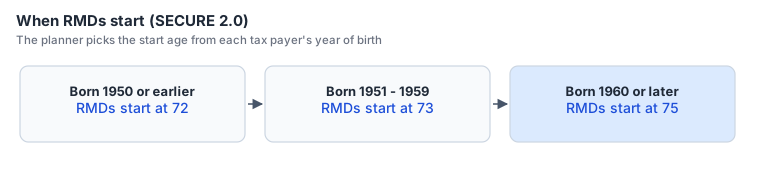
Under the SECURE 2.0 Act, the start age depends on the year of birth. The planner takes it from the account owner's year of birth on the Tax Payers page. RMDs apply to IRA and 401(k) accounts; Roth accounts have no RMDs for the owner.
How an RMD is calculated
For each IRA and 401(k), every year from the start age:
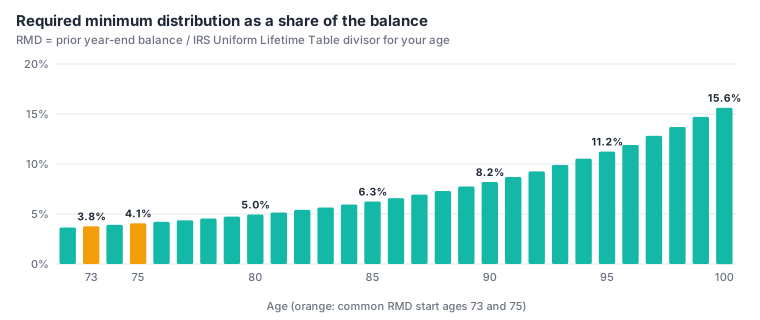
RMD = balance at the end of last year ÷ divisor for your age this year
The divisor comes from the IRS Uniform Lifetime Table in the RMD Table. At 75 it is 24.6, so the RMD is 4.07% of the balance; at 80 it is 4.95% and at 90 8.20%.
An example
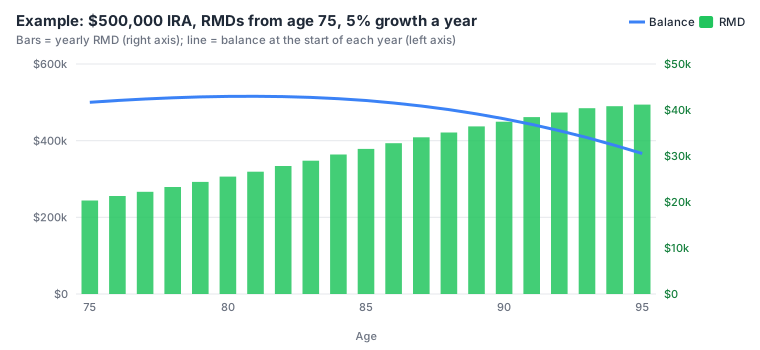
A $500,000 IRA growing 5% a year has a first RMD of $20,325 at 75. Because the percentage rises every year, the RMD keeps growing - $31,543 at 85 and $41,174 at 95 - even as the balance starts to shrink. Larger RMDs mean more taxable income, which can also make more of your Social Security taxable and raise your Medicare premiums.
What the planner does
- The RMD is taken from the account's investments in proportion to their balances and paid into the cash account, where it is available for spending.
- It is reported on Form 1040 line 4a (IRA) or 5a (401(k)) as ordinary income.
- The account owner's (trustee's) age is used. A joint account uses tax payer 1's age, and after the owner's death the surviving tax payer's age is used.
- If you already withdrew more than the RMD from an account, the planner still takes the RMD in the RMD step - money taken by Auto later in the year does not count toward it.