
Investments Preview
Your money is organized in three levels: the financial institutions you use, the accounts at each one, and the investments held in each account.
Screen in progress
The picture is a mockup. The fields and rules are already used by the calculations.
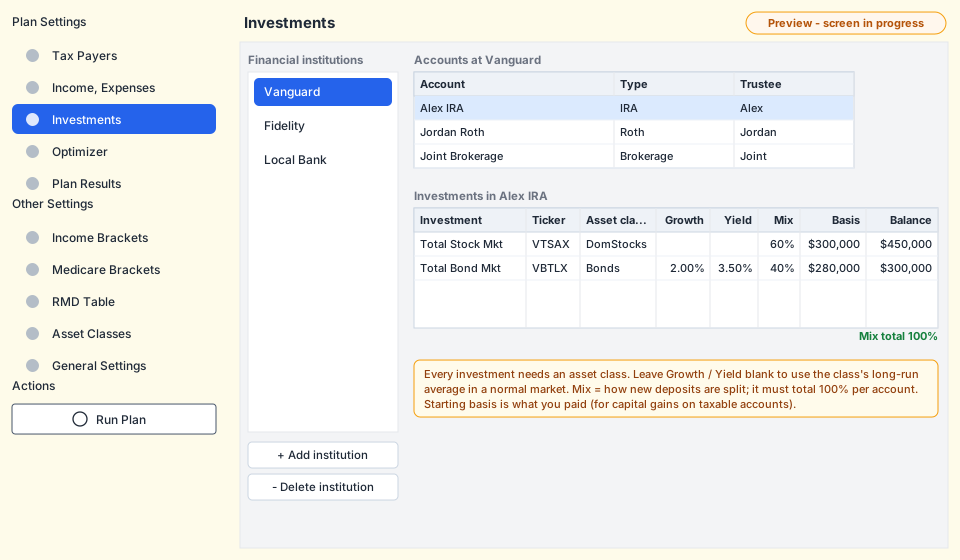
Financial institutions
A bank, brokerage or fund company - for example Vanguard or your local bank. Account names in drop-downs and results show the institution, such as "Joint Savings (Local Bank)". Deleting an institution deletes its accounts and investments.
Accounts
| Field | Meaning |
|---|---|
| Name | Your name for the account. |
| Type | Decides how the account is taxed and how it is used (table below). |
| Trustee | The owner: a tax payer, or Joint (only offered with two tax payers). For an IRA, 401(k) or Roth, the owner's age decides when RMDs start and when Roth conversions stop. |
Deleting an account deletes its investments. Income paid into it is left without a To account (pick a new one before running the plan), and expenses paid from it switch to Auto.
| Type | Tax treatment | How the planner uses it |
|---|---|---|
| Savings | Taxable: yields are taxed every year by their asset class (interest, dividends, tax-exempt interest); sales realize capital gains or losses | Auto withdrawal 1st. First choice for the cash account. |
| Checking | Not used by Auto. Second choice for the cash account. | |
| Brokerage | Auto withdrawal 2nd. Third choice for the cash account. | |
| IRA | Withdrawals are ordinary income (1040 line 4a) | Auto 3rd. RMDs. Source for Roth conversions. |
| 401(k) | Withdrawals are ordinary income (1040 line 5a) | Auto 4th. RMDs. Source for Roth conversions. |
| Roth | Tax free | Auto last. Receives Roth conversions. |
| HSA | Tax free | Not used by Auto; grows unless an expense names it as From. |
| 529 | Tax free | Not used by Auto; grows unless an expense names it as From. |
Investments
| Field | Meaning |
|---|---|
| Name, Ticker | For your reference, for example "Total Stock Market" / VTSAX. |
| Asset class | Required. DomStocks, IntStocks, Bonds, MuniBonds, Gold, Cash or a class you add. It supplies the growth and yield when you leave them blank, the down-market history, and the 1040 boxes for taxable accounts. See asset classes. |
| Growth | Expected price growth, % per year. Leave blank to use the asset class's long-run average (6.49% for domestic stocks). |
| Yield | Expected dividends or interest, % per year, reinvested. Leave blank to use the class average (1.75% for domestic stocks). |
| Mix | How new money paid into the account (income, Social Security, RMDs, Roth conversions) is split between its investments. The mixes in an account must add up to 100%. New investments get whatever is left. |
| Starting basis | What you paid for the investment (its cost basis). Used to work out capital gains when it is sold in a taxable account. Ignored for IRA, 401(k), Roth, HSA and 529. |
| Starting balance | Today's value. |
Growth and yield in the two markets
In the normal market an investment uses its own Growth and Yield, or the class average when they are
blank. In the down market every investment follows its asset class's real history instead, starting
in the worst year for your holdings. See normal and down markets.
How balances change
- Each year an investment grows by its growth rate and earns its yield on the balance at the start of the year; the yield is reinvested.
- Deposits are split by Mix; withdrawals are taken in proportion to balance, and investments that lost value that year are sold last. The planner does not rebalance.
- Sales from taxable accounts use the average cost: a sale of 10% of an investment uses 10% of its basis. Reinvested yields are added to the basis.
Checks before a run
- Every investment must have an asset class, and every class you use must have complete performance history.
- Each account's investment mixes must add up to 100%.
- The plan needs a Savings, Checking or Brokerage account with at least one investment to receive Social Security and RMDs.