
Roth conversions
A Roth conversion moves money from a traditional IRA or 401(k) into a Roth account. You pay income tax on the amount now; after that it grows tax free, is withdrawn tax free and has no RMDs. Converting in low-income years can lower your lifetime taxes.
Why convert?
- Fill low brackets. Between retirement and Social Security or RMDs, your income may be unusually low. Converting fills the 10%, 12% or 22% brackets that would otherwise go unused.
- Smaller RMDs later. A smaller IRA means smaller required distributions in your 70s and 80s, which could otherwise push you into higher brackets.
- Less tax on Social Security and lower Medicare premiums later, because Roth withdrawals are not income.
- For a surviving spouse, who files single with narrower brackets, and for heirs.
The cost is paying tax now - and the money used to pay it no longer grows for you. Whether conversions pay off depends on your tax rates now versus later, which is exactly what the optimizer tests.
Roth buckets
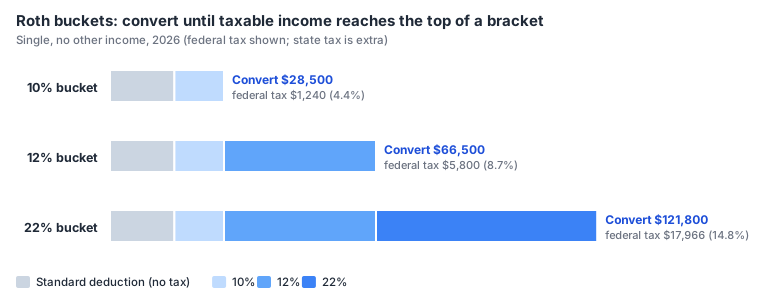
A Roth bucket is a tax bracket to fill. Each year, the planner converts just enough to bring taxable income up to the top of that bracket. The planner starts with three buckets - the 10%, 12% and 22% brackets - for your filing status. For a single person with no other income in 2026:
| Bucket | Fill taxable income to | Convert | Federal tax |
|---|---|---|---|
| 10% | $12,400 | $28,500 | $1,240 |
| 12% | $50,400 | $66,500 | $5,800 |
| 22% | $105,700 | $121,800 | $17,966 |
The conversion is larger than the bracket because the standard deduction ($16,100) comes first. Any other income - wages, a pension, taxable Social Security, dividends, RMDs - uses up part of the bucket, so less is converted. State tax is extra.
How the planner converts
- Conversions happen every year until the owner's RMDs start (72, 73 or 75 depending on year of birth), and only while the owner is alive.
- The money comes from the owner's IRA and 401(k) accounts, in proportion to their balances, and goes into the owner's Roth account. If the owner has no Roth, any Roth account in the plan is used. The plan needs a Roth account with at least one investment for conversions to happen.
- The bucket's limit rises every year with the tax forms inflation rate, and follows the filing status (married limits while both are alive, single after).
- Conversions are reported on Form 1040 line 4a (from an IRA) or 5a (from a 401(k)) and shown as Roth Conversion in the cash flows.
- The tax on the conversion is paid by Auto with the rest of the year's taxes - from savings first, which is usually what you want.
Run Plan does no conversions. The optimizer tries no conversions and each bucket in turn.