
Reference tables and settings Preview
The pages under Other Settings hold the tax tables and market data the planner uses. They come filled in with 2026 values, and the planner raises the dollar amounts each year with inflation. Most people only need to change the state tax brackets and the general settings.
Income Brackets
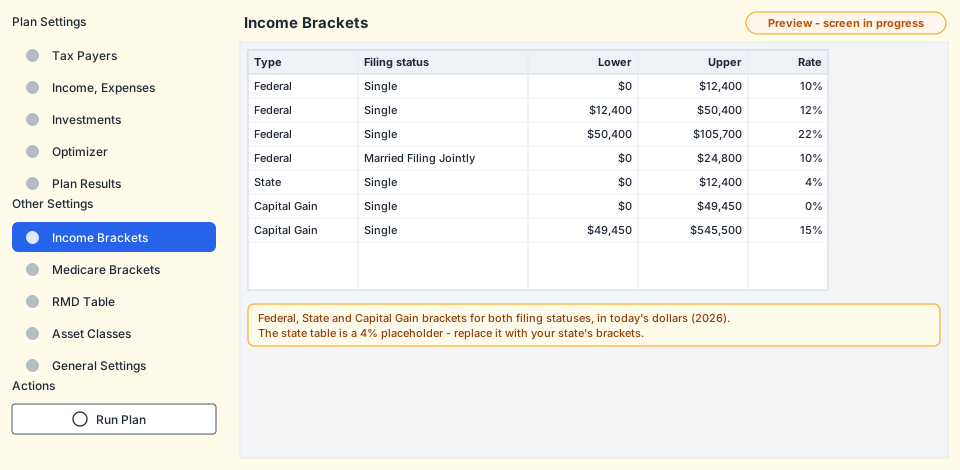
Three kinds of brackets, each for single and married filing jointly:
- Federal - the seven 2026 ordinary income brackets (10% to 37%).
- State - a 4% flat placeholder. Replace it with your state's brackets, or set the rate to 0% if your state has no income tax. State tax is applied to federal taxable income plus tax-exempt interest.
- Capital Gain - the 0%, 15% and 20% brackets for long-term gains and qualified dividends.
See income taxes and deductions for how they are used.
Medicare Brackets
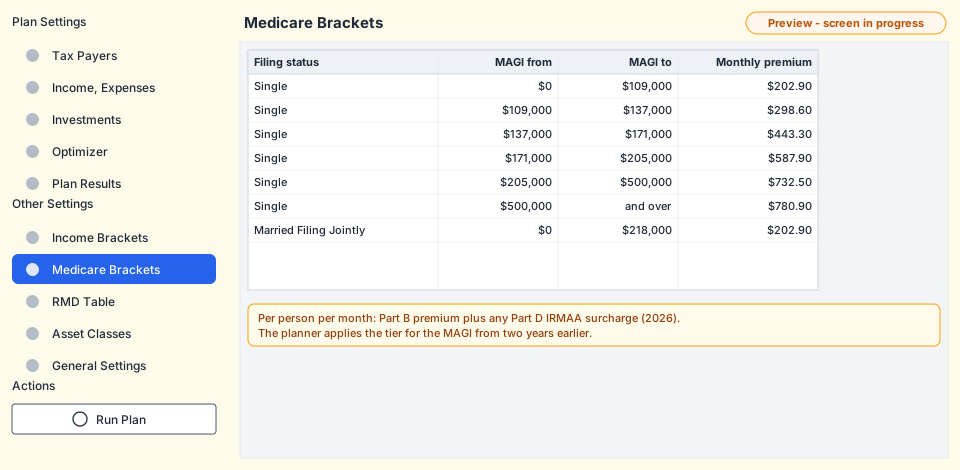
The 2026 IRMAA tiers: for each filing status, a modified AGI range and the monthly premium per person (Part B plus any Part D surcharge). See Medicare and IRMAA.
RMD Table
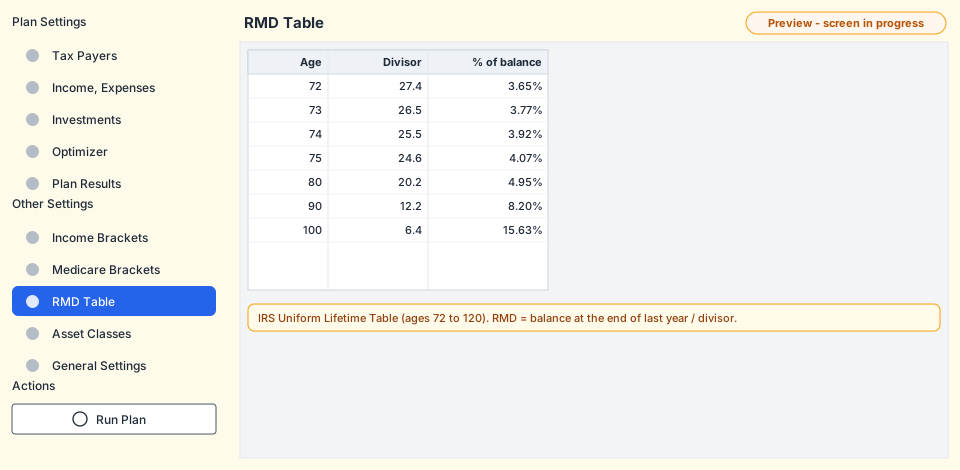
The IRS Uniform Lifetime Table for ages 72 to 120: the divisor for each age and the share of the balance it works out to. See required minimum distributions.
Asset Classes
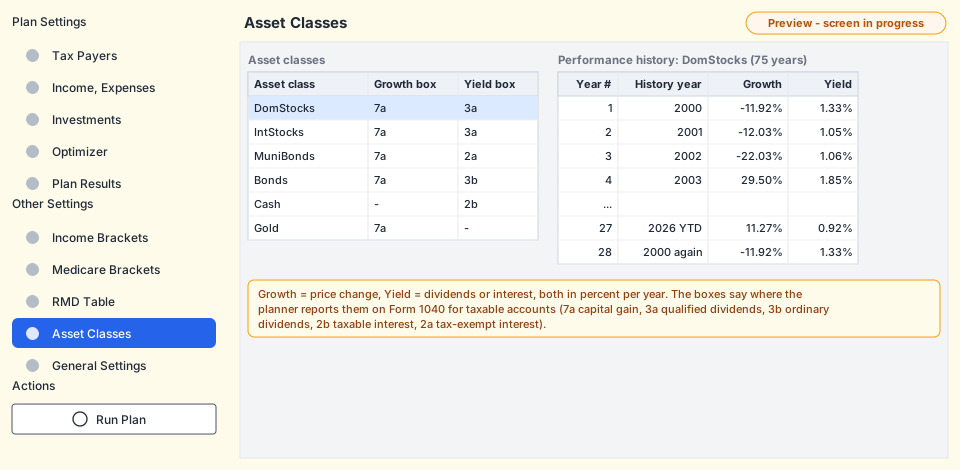
Each asset class has the Form 1040 boxes its growth and yield are reported in, and a yearly performance history. The six starting classes are loaded with real 2000-2026 history. See asset classes.
- You can add your own classes. Every class's history must start in the same calendar year (history year 1), so that all classes rise and fall together in the down market.
- An asset class still used by an investment cannot be deleted.
General Settings
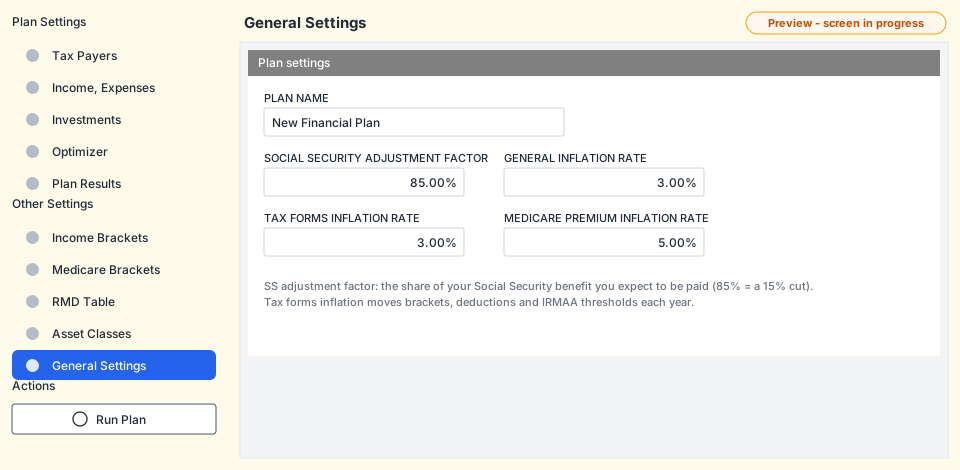
| Setting | Default | Meaning |
|---|---|---|
| Plan name | New Financial Plan | For your reference. |
| Social Security adjustment factor | 85% | The share of your Social Security benefit you expect to be paid. 85% plans for a 15% benefit cut; use 100% for no cut. |
| General inflation rate | 3% | Default inflation for income and expenses, and the yearly Social Security cost-of-living increase. |
| Tax forms inflation rate | 3% | How fast tax brackets, the standard deduction, the 65+ add-on, Roth buckets and IRMAA thresholds rise. |
| Medicare premium inflation rate | 5% | How fast Medicare premiums rise. Healthcare costs have usually risen faster than prices in general. |