
CashTank Financial Planner
The financial planner in CashTank Budget projects your finances year by year, from today to the end of your life expectancy. It shows whether your money lasts and how much tax you pay along the way. It can also try hundreds of retirement, Social Security and Roth conversion choices to find the plan that holds up best.
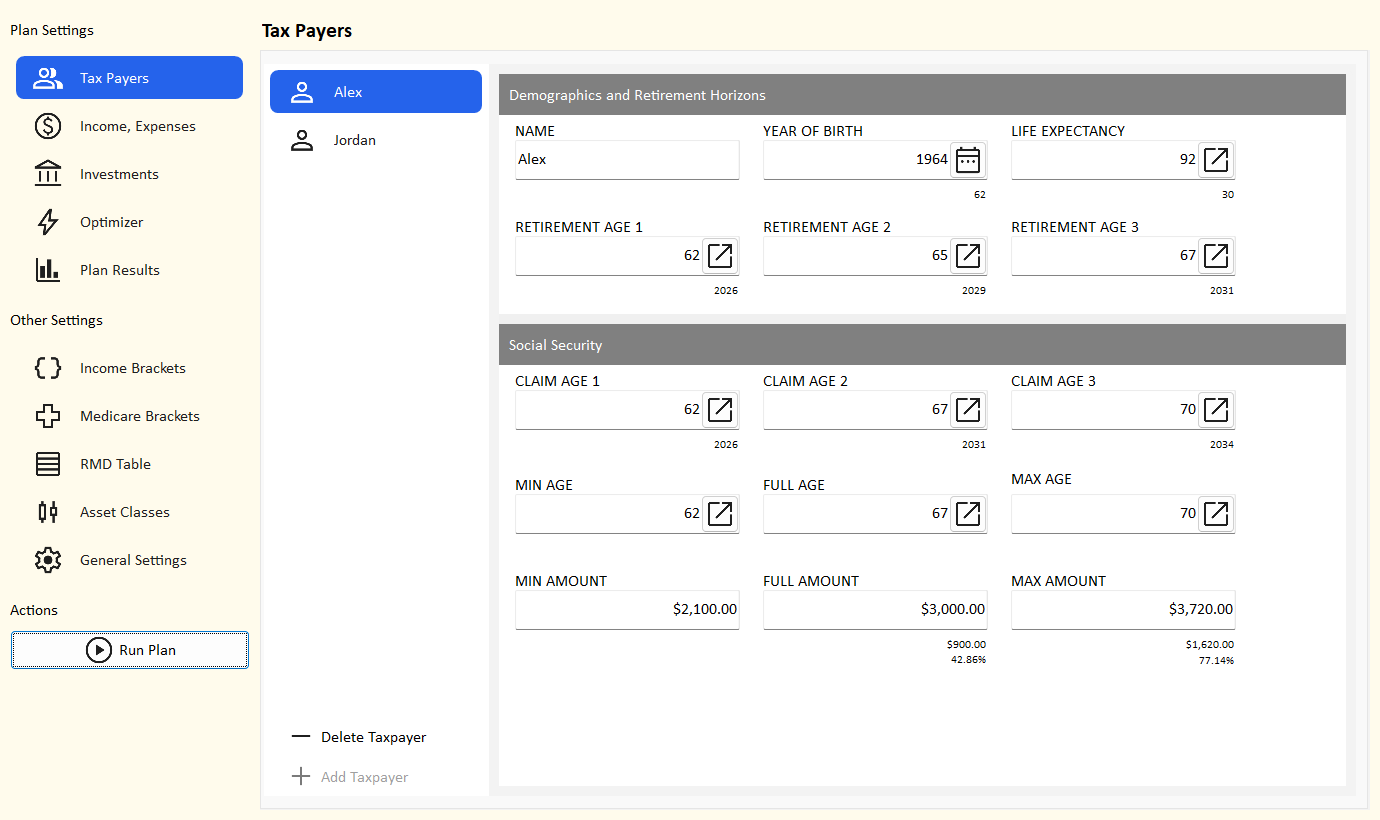
What the planner does
- Simulates every year of your plan: investment growth and yield, wages, pensions, Social Security, required minimum distributions, Roth conversions, living expenses, income taxes and Medicare premiums.
- Fills in your tax forms for every year (Form 1040 and the Social Security benefits worksheet), so you can see where each dollar of tax comes from.
- Tests a bad market. Besides a "normal" market built from long-run averages, it replays real 2000-2026 market history starting at the worst point for your mix of investments.
- Optimizes. It runs every combination of your retirement ages, Social Security claim ages, Roth conversion buckets and both market scenarios, and picks the one that lasts longest.
Find your way around this manual
Getting startedBuild your first plan in nine steps.
ScreensEvery page of the planner, field by field.
How the plan worksWhat happens each year, and the assumptions.
Asset classesGrowth, yield, real market history and the down market.
Taxes and deductionsBrackets, age 65+ breaks, capital gains, Social Security tax.
RMDsWhen required distributions start and how big they get.
Medicare and IRMAAWhy income two years ago sets your premium.
Roth conversionsFilling a tax bracket on purpose.
GlossaryPlain-English definitions of every term.
Screens built and in progress
The planner is still being built. Each screen chapter is marked:
- Built - the screen works as described and the pictures are real screenshots.
- Preview - the calculations behind the screen are finished, but the screen itself is still being designed. The pictures are mockups and details may change.
An educational tool, not advice
The planner uses 2026 tax rules and simplifies some of them (see
assumptions and simplifications). Real markets will not repeat
history exactly. Use the results to compare choices and ask better questions, and check important decisions with a tax or
financial professional.